Ricardo and Juanita Move to Mexico
 They had lived in Houston for twenty-seven years where they led a conventional life. They raised three children, Juanita ran an interior decorating business, and Ricardo worked at a high-pressure job selling industrial packaging. He ended up having cardiac bypass surgery and he burned out. He may have been convalescing and vulnerable to suggestion when he came across the article that a friend had sent him some five years before. It had lurked quietly in wait for him, tucked away in one of his drawers. He happened on it, picked it up and read it again. It told about a town in Mexico where people socialize, have parties and their sex life improves.
Sounds good to me, he thought. So Ricardo did some research on desirable places to live in Mexico and bought a book that listed a number of good gringo habitats. He compiled his own short-list which included Lake Chapala and San Miguel de Allende, went in to work and quit his job. He gave Juanita the date of his last work day and his destination list. He thought one house for rent near Lake Chapala looked interesting.
“You should go and check these out,” he said.

Neither Ricardo nor Juanita had visited anywhere in Mexico except for quick forays across the border. Juanita showed Ricardo’s list to the woman from Mexico who sewed drapes for her. The Drape Lady shook her head. “I don’t think you will like gringo cities. I will take you to the places you have listed, but I will show you the real Mexico, too.”
“How will we travel?” asked Juanita.
“By bus,” said the Drape Lady.
So Juanita and the Drape Lady took two weeks off work and clambered onto a Chicken Bus. The bus was full of people and kids and wares of all sorts and, of course, from time to time, the requisite chicken or two. Juanita was worried that she would get traveler’s intestinal complaint. So she pressed her lips together firmly and resolved that, no matter what was offered, on her two week quest she would eat only rolls and avocados.

They visited a string of places. First the Drape Lady took Juanita to visit a house that she owned in the interior of Mexico. They had a nice stay, but the resources of the small town seemed too limited. On a succession of Chicken Buses they moved on, staying with drape-lady relatives here and there. “The gringa only eats rolls and avocados,” hospitable relatives noted at abundant meals.
In San Luís Potosí, there were no relatives so they took a taxi from the bus to a hotel. The driver pulled up to an establishment with women standing out in front. Their behavior and dress advertised their trade. This rattled the Drape Lady out of her usual equanimity. “No, no!” she insisted, waving her arms in the air. The taxi driver delivered them to a less colorful establishment. Juanita crossed San Luís off the list.
The two women visited Morelia. “Too busy, not here either,” remarked Juanita.
 They proceeded to Pátzcuaro to stay with drape-lady relatives who lived in a modest enclave behind the bus station. Their house was well-kept and very pleasant. A cousin generously drove them to Chapala and Ajijic. Juanita visited the house that rented for US$750 per month. Chapala and Ajijic were nice, but everything "was in English." Juanita wanted more of Mexico. They visited Jocotepec, at the west end of Lake Chapala. It was tranquil, very Mexican and everyone spoke Spanish. Juanita could not talk to anyone. Great, she mused. I like this pueblo.
They visited San Miguel de Allende. Here Juanita again found English everywhere. The people whom she stopped to ask about San Miguel were too busy to help her. Not promising.
When they returned to Pátzcuaro, the relatives showed Juanita a house for rent down the street from theirs. It was vacant and she peeked in the windows at dusk. Although she could not see much detail, even in dim light the colors inside looked bright. She called Ricardo. “We’re moving to Pátzcuaro,” she said.
“Patz-what?” said Ricardo. He examined his list carefully. “That’s not on my list.” He paused. “Where is it?” he asked.
“I found a house. You’ll like it,” responded Juanita.
“What does it look like,” he queried.
“I don’t know. I haven’t seen it in the daylight. But you drive on a three-lane boulevard to get there. And it’s in a gated community.”
This sounded good. Ricardo had high expectations.
When Juanita returned to Houston, she and Ricardo began negotiations and somewhere during the course of things their plans to rent turned into plans to buy. To surmount the language barrier, they telephoned the Drape Lady in English, who telephoned the cousin in Spanish, who called back the Drape Lady, who in turn responded to Juanita and Ricardo.
 “Let me negotiate the house for you,” said the cousin. “I can get a better price.”
To answer the cousin, they started through the translation circuit all over again.
“Send me money,” said the cousin. They did. He obtained the house for them.
“It needs paint, a sink and the water storage tank needs to be cleaned. My father and brother will help me. Send me more money,” said the cousin.
They sent more money.
The move was not too difficult because Ricardo and Juanita had already downsized their household once their children were grown. But they needed to downsize some more. They told each one of their children to pick out the ten things he or she would most like to have. If two wanted the same thing, a roll of the dice determined possession. They sold one car and loaded a U-haul to take to a freight forwarder in Laredo.
“By the way,” said Juanita. “We need to take a sink.” Ricardo said that should have been his most obvious clue.
“I still don’t know where I’m going,” said Ricardo. They called the Drape Lady. “I need directions. Ask your cousin how I get there,” Ricardo told her. One would assume the directions included something to the effect that they should drive south some distance and eventually turn right at Morelia.
The Drape Lady called. “My cousin wants to know what day you will arrive, so he and his father and brother can help you unload.”
“It will probably take a couple of days.”
On June 11, 2001, Ricardo and Juanita set out early on a fine day with their dog and four cats. They delivered their things to the freight forwarder and continued. Ricardo was committed to driving only in daylight hours, but by nightfall no hotel would take their menagerie at any stop, so each time they tried to get a room they went back out to the car and pushed on. By early morning hours of the next day the bedraggled pair arrived in Morelia. There they managed to check into a horrible hotel. Three hours later loud morning activity under the window of their room routed them groggy out of bed.
They finally made it to Pátzcuaro. Juanita could not remember exactly where the house was. “I know it was by a bus station,” she said. They eventually got directions. The Libramiento of Pátzcuaro that led them toward the house, before its current improvements, did not exactly match Ricardo’s mental picture of a three-lane “boulevard.” The two found their gated community in back of the bus station. Ricardo went into culture shock. The various houses on their street were painted a multitude of bright, happy colors. This was not staid U.S. suburbia. Ricardo suddenly remembered that Juanita had made him bring a sink. “Please tell me there aren’t dirt floors. Please.”
So on June 12, 2001, with help from the Drape Lady’s relatives, they moved into their house. The one installed sink worked more or less. The bathroom was a bracing purple. There were cement floors of a sort. The Houston apartment suddenly seemed palatial.
Juanita’s interior decorating experience kicked in. Construction began. They moved walls to make a larger kitchen. They added a downstairs bathroom. Juanita designed bathroom counters and picked beautiful Mexican colors. It was chaotic living in a jobsite, but the workers were willing and skilled, and finally the renovation phase was over.
The result was worth the wait. One walks through the front door into an oasis of tranquility in this two-bedroom, two-bath, two-story house. It is full of light and art and pleases the senses. The façade of the house is simple and understated; basically unchanged, it blends in with neighboring homes. Their finished house project cost them much less than it would have cost for a similar house in Houston. In addition, they can live comfortably on their social security income, something that would not be possible for them in the United States. Juanita and Ricardo certainly made an advantageous financial move.
What do they like about their life in Pátzcuaro? Three things top a long list. They like the people, whom they find to be helpful and friendly. They love the activity of the Centro of Patzcuaro: the market, the parades and the festivals. And they enjoy the small expatriate community. They comment that within a fifty-mile radius, there is much to do and see. Ricardo and Juanita also enjoy their neighbors. On arrival, Ricardo walked their dog three times a day. The dog’s name was Happy, and the tall gringo and his dog soon became a familiar sight. Sometimes neighborhood children would call to him, “Hola, Ah-pee!”, addressing him by his quadruped’s name.
Their neighbors all watch out for each other, including Ricardo and Juanita. And on September 11, 2001, three months after Ricardo and Juanita moved into their house, the neighbors in their area came over to express their sorrow at the tragedy that had taken place in the United States.
As for some practical considerations, Ricardo and Juanita study Spanish when they can make time. Juanita has a neurologist in Morelia, forty-five minutes away. When she suffered a stroke, she received excellent care. The initial cat-scan and two-hour consultation cost $2,000 pesos. Ricardo found a cardiologist and he had knee-surgery (different physicians for heart and knee, you will be glad to know). He also is very pleased with his medical care. Their dentist is conveniently located in Pátzcuaro.
Ricardo and Juanita feel comfortable and secure in their daily activities. They regularly drive to all the villages around Pátzcuaro. They go with friends to eat, sightsee, and look for arts and crafts. They say they enjoy life in Pátzcuaro more than in Houston, with more time for themselves and more social life. They acknowledge that this may in part be due to retirement, but largely it is because of the interesting variety of activities available, the friends they have made in the small community, and the lower cost of living. Their dog Happy is no longer with them. Today another dog, Buddy, and two cats keep them company. Guests visit from time to time.
What do they miss? Shopping in the U.S. for clothes and some favorite foods they instantly answer—coincidentally a favorite pastime for mexicanos, too, when they visit their neighbor to the north.
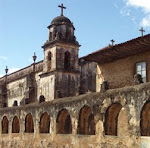
In magical Pátzcuaro, a colonial pueblo that nestles at 7200 ft. in the mountains of Michoacán, an area of lakes, oak and pine forests, and waterfalls, Ricardo and Juanita enjoy their lifestyle. For this they give thanks to the Chicken Bus—and to the kind and enterprising Drape Lady.
1. A Pátzcuaro site for expats http://www.lakepatzcuaro.org/
2. Join for community and practical tips http://groups.yahoo.com/search?query=michoacan_net
3. There is a house for you in Patzcuaro http://www.novinger.com/patz-homes.htm


.JPG)
.JPG)
.JPG)
.JPG)
.JPG)
.JPG)

.JPG)


.JPG)


.JPG)