Showing posts with label Flora and Fauna. Show all posts

Saturday, July 13, 2013

Batty over Bats


Using easy round numbers, there are approximately 4,000 mammal species in the world and bat species constitute close to 1,000 of them. Bats are especially important in arid and semi-arid climates that have night-blooming flowers. These plants depend on bats for pollination.

See Bat Conservation International.

Jennifer J. W. Vann and Rocío Diaz M. are working on bat conservation as well as agave and mezcal projects in Michoacán and plan to produce a documentary. Visit them at http://conceptocircularte.blogspot.mx/ 

It is exciting to see this project. Bats are varied and interesting, but often maligned in folklore and people's beliefs.

Mediterranean horseshoe bat

Look at this cute guy.

Get batty!

Wednesday, August 8, 2012

Our Beautiful Fig Tree

DSCN9030
El Higuero

The little stick we stuck in the ground has grown into a large, beautiful and very productive fig tree. Small green nubs grow into a profusion of fruit. Our mouths begin to water as we watch for it to ripen. The figs seductively plump out and then turn a deep purple color. We palpate their curves gently with our fingers. The trick is to beat the ever vigilant birds. We race to see who gets the ripe ones first. It is a let-down to go to that fat fig of yesterday that was almost ready and find that today, just as we thought, it is perfect—and now full of holes. The early bird gets the fig?

Glen came up with a good idea. He searched on the internet for a recipe to make preserves from green (unripe) figs and yesterday made five pounds of these into preserves. Very tasty! And there is still an abundance of fruit on the tree for which we will compete as the figs ripen.

DSCN9029

Making Citrus Marmelade

Life is Sweet

Palate Pleasing Papaya

Sunday, July 1, 2012

A Colonial Pueblo

When I am out patzcuareando, street scenes like this remind me that Patzcuaro still offers a look at traditional Mexico in a small and very livable colonial pueblo. Horses are a daily and important part of local culture.

work horse (2)

work horse (1)

Tuesday, December 20, 2011

My Lush Floripondio


 The Floripondio/Datura in the garden flourish. The sap is said to contain scopolamine. I content myself with inhaling the scent of the blossoms that trails heavily through the night air. I love my garden.
 My Noche Buena/Poinsettia for Christmas.

Sunday, October 30, 2011

Las Flores –The Flowers

The flowers (zempasúcitl / marigolds)  and their fragrance fill Calle Serrato next to the Basílica. Don’t miss a stroll along this street where people go to buy flowers for Night of the Dead / Noche de Muertos. The flowers will be used for decorations, altars and at the cemeteries.

patz 012patz 013patz 015

A field of zempasúchitl flowers.

Flower slide show on Flickr.

Pátzcuaro living.

Friday, October 7, 2011

The rains have passed…

…and myriad flowers regale our eyes. I stand and drink in the fields of Cosmos as their faces follow the sun.

Mirasoles Lake PatzPatz 012 (2)PICT0029 (2)

Flora and Fauna
Rain
Patzcuaro…life is good.

Tuesday, November 2, 2010

Noche de Muertos 2010–#11

Pilgrimage on Horseback

On November 1, 50 riders set out from Morelia on horseback to make a pilgrimage to Pátzcuaro. Every year the pilgrimage keeps gathering riders from pueblos along the way, until they finally number from 600 to 1,000 on arrival at the Plaza de la Basílica. This massive procession on horseback pays homage to Nuestra Señora de la Salud, who is venerated at the Pátzcuaro Basílica.

The ride started in the dark at 5:00 AM and the caballeros and caballeras starting arriving in streams at 5:00 PM at the Plaza. In the fading light, the earthy smell of the horses permeated the air, while the occasional clatter of restless hooves, the snorts of horses pulling at their tethers and their nickers punctuated the burble of satisfied conversations.

This year no horses were permitted to enter the small courtyard area adjacent to the Basílica or the edifice itself because of restored paving and flooring. Mass was held to the jingle of spurs as those who were standing occasionally shifted their weight from foot to foot.

See a series of posts on Night of the Dead in Patzcuaro.
Patzcuaro bound?

Wednesday, October 6, 2010

Noche de Muertos 2010 - #3

Flor de Ánimas

Yunuen 116

Flower of Souls
Flor de Ánimas, Yunuén Island
Laelia autumnalis

All over Mexico the ubiquitous zempasúchitl flower(marigold) marks the observance of death. On the Meseta Purhépecha, the high Purhépecha Plateau, in addition to the marigold, a flower less well known is important and traditionally used for celebration of Night of the Dead. This is the delicate purple orchid, endemic to Mexico’s central highlands, called Flor de Ánimas (Flower of Souls). This orchid blooms abundantly in the fall in high oak forests. I have seen these blossoms in profusion on the nearby island of Yunuén on Lake Pátzcuaro.

The Orchidaceae epidendroideae epidendreae laeliinae laelia autumnalis grows in Mexico in the central to southern mountains at elevations of 1500 to 2600 meters. The blooms are fragrant and long-lasting. The bulbs of this orchid is one type of those traditionally used to make a paste mixed with cornstarch to mold figures such as that of the Virgen de la Salud in Pátzcuaro’s Basílica. Some medical research indicates that an extract of this orchid has antihypertensive and vasorelaxant properties; it is also said to cause abortion.

If you are an orquidophile, visit Artesanías La Mojiganga on Patzcuaro’s Plaza Vasco de Quiroga. The owner, Felipe de Ortega, helped me indentify the exact species and scientific name of the Flor de Ánimas. He has many types of orchid plants and items necessary to cultivate orchids.

The myriad orchid plants that Glen has put in the trees in our garden at La Jacaranda are busy pushing out the long, thin shoots that will bear the Flor de Ánimas. And soon we will see vendors offering long stems of these orchid blooms in the streets around the central plazas of Pátzcuaro. These and the street full of flowers that is set up next to the Plaza de la Basílica will herald the individual altars and the decorations in homes that are traditional for Night of the Dead.

Hasta más.

P.S. October 12th - Flor de Ánimas blossoms opened today on two of our plants in the trees at La Jacaranda. What a pleasure.

Links:
Mexican Association of Orchidology http://amo.com.mx/
More about Night of the Dead around Lake Pátzcuaro.
Photos on Flickr of
The Flowers.
Why not live in Patzcuaro?

Thursday, September 30, 2010

Noche de Muertos 2010 - #1

More coming soon on Noche de Muertos...watch this site.


Everywhere around Lake Pátzcuaro fields of zempasúchitl, a species of bright orange marigold, are being cultivated for Night of the Dead. Take particular note of the usage "Night" of the Dead. The rest of Mexico observes Day of the Dead and many mexicanos come to Pátzcuaro to observe the unique customs of the Purhépecha pueblos around the lake. In fact, some 95% of Pátzcuaro visitors year-round are mexicanos, which makes for a very traditional ambiance.

Common both to the town of Pátzcuaro and to the pueblos are flowers, decorations and bedizened altars during the week that precedes Noche de Muertos. However, the vigil in the cemetery of Pátzcuaro proper is held during the day, as in the rest of Mexico, while the singular vigil in the lake pueblos is held at night.

More about Night of the Dead around Lake Pátzcuaro.

Photos on Flickr of The Flowers.

Photos on Flickr of The Cemeteries.

Why not live in Patzcuaro?

Tuesday, September 14, 2010

Palate Pleasing Papaya

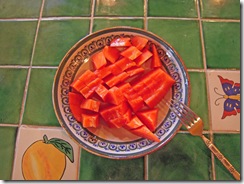
I love plump, palate-pleasing papaya and can eat this fruit in astonishing quantities. I have eaten it most of my life, except for stints in cold so-called temperate climes from which I have fled. In Pátzcuaro I can buy my ripe papaya at the street market by Plaza Chica in every month of the year and I do not have to pay a king’s ransom to end up with a greenish, unripe, tasteless fruit.

Here are some exciting facts to wade through on your way to the anecdotes following. The probable origin of the papaya is Mexico and Central America. Even though it looks like a tree, the papaya plant is classified as a large herb, Herbaceous perennial. It grows worldwide in tropical climates. Papayas are the only natural source of papain, which naturally aids digestion. It breaks down protein and cleanses the digestive track so that less food metabolizes as fat.

papaya3

Papayas are rich in vitamin C, folate, and potassium, as well as providing fiber, vitamin A, vitamin E, the eye-saving carotenoids lutein and zeaxanthin, and lycopene. For nutritional value, papayas rank in the top three fruits. They have 13 times more vitamin C and more than 2 times the potassium of apples; they have 4 times more vitamin E than both apples and oranges. All that and it tastes good, too.

Did you know that papain is the tenderizing ingredient in Adolph’s meat tenderizer? Check the label in a store somewhere sometime. In Tahiti we used to use the papaya leaf to tenderize a tough cut of meat. We would buy “steaks” and wrap each one in a washed papaya leaf. We then placed the packets in the refrigerator overnight and the next day, voilà, we had tender steaks instead of having to attack the slabs with our machetes. If we left the meat in the leaves for a second day, I accidentally found out that it had begun to predigest—rather slimy and not at all appetizing.

See full size image

On a holiday week-end, when we had more time off from work, we would hike two hours past the end of the road on Tahiti-Iti (the little part of the island’s figure 8) and camp by a river and waterfall. There we would spear fish and grill them on coral heated in a wood fire. Once a hapless feral chicken showed itself and it was hunted down with a fishing spear-gun. It was a tough, wiry bird, before and after its untimely demise. I shinnied up the trunk of a papaya “tree” and picked several green papayas. We peeled and seeded them and cut them up like squash. We simmered the chicken with chopped onions and garlic which we had brought, and the green papaya. The papaya tasted like squash and it tenderized the chicken beautifully. Healthy and tasty over rice.

When my children were infants, to introduce fruit with vitamin A and C into their diet, I would scrape the papaya flesh with a spoon and feed the resulting purée to them. Much less acid than orange juice, babies can have papaya when they are tiny. They digest it well and it is very good for them.

In Patzcuaro I eat papaya almost every morning (I confess that I do like variety from time to time). I am so spoiled. Maybe ripe, voluptuous mangos mañana…

Saturday, August 14, 2010

Me in My Fig Leaf

Aha. Got your attention in a devious way.

We planted a little stick of a thing at La Jacaranda and it has flourished into a lush fig tree. This year, after practicing for a few seasons, the tree is laden with fruit. The figs ripen into a deep wine color and taste delicious. I love birds, but right now I wish my blankety-blank little feathered friends would stop beating us to the ripe figs.

Friday, May 14, 2010

My Luxuriant Jacaranda

The eponymous jacaranda tree at Villa La Jacaranda is laden with lavender-colored blossoms, and rains its petals in the front yard. I have never seen it so luxuriant. Soon, I hope, the jacarandita in back will also grace us with a plethora of blooms.

Friday, February 26, 2010

Try Rattlers and Moles


A friend of mine in Patzcuaro, I will call her FP, unfortunately has contracted H. Pylori which has resulted in a bleeding ulcer. She also has some enlarged lymph nodes that have suspicious cells. Her housekeeper, call her Maria,  is very concerned for FP, and yesterday Maria explained to her that she can be totally cured of the H. Pylori as well as any latent cancer by a natural cure that is purported to cure even a late diagnosis leukemia.

It seems that in a pueblo called Santa Ana, not on the way to Erongaricuaro but farther away where men live in a hill cave, the Purhépechas collect what is needed for this miracle cure and come into Patzcuaro to sell their remedies. The cure consists of two different food dishes and you must eat both (not necessarily at the same time). The first is a stew made of serpiente de cascabel (rattlesnake) and the second a stew made with tuza, a mole. The mole is believed to be a very clean animal because it eats only specific plant roots, and it is also thought to be highly nutritious. Veggies, rice, pasta, potatoes, beef, or chicken, etc. can be added to the stews, but never pork or chiles.

Maria wanted to immediately have the Santa Ana gatherers procure the requisite moles and snakes (cleaned and dressed, by the way) for today. FP thought she had tactfully postponed this therapy by saying she wants to first finish her fourteen-day "mega antibiotic" treatment. But the response was that the stews do not interfere with regular (allopathic) medicines, and that she should proceed immediately. For someone who has not been able to eat much of anything because of an ulcer, it would seem that right now eating-therapy would be problematic. However, because Maria wants so much to help, FP dutifully ordered moles and snakes. Her taste buds are tingling in anticipation. She will have her housekeeper do the stewing.

Last week FP was given another tip:  drink "potato water". Agua de papas is made by dicing or grating whole potatoes, skin and all, and soaking them in water for several hours. One then drains off the water and saves it in a large container. Drink one glass each morning. FP's husband makes the dirty-looking water for her--and then fries up delicious hash browns for himself. Another Patzcuaro friend claims the water soothes the stomach better than any modern product and that he himself was cured of a serious bleeding ulcer by potato water only. Good news: FP reports that the agua does indeed soothe her stomach lining, whereas Nexium did nothing.

Much of the tourism to Patzcuaro is by devout mexicanos who come on a pilgrimage to petition Nuestra Señora de la Salud (Our Lady of Health), the pueblo's patron saint, for healing. In front of the Basílica, every day vendors sell folk cures for ailments from arthritis to kidney troubles. The daily market also sells many kinds of medicinal herbs. FP feels genuinely touched by the sincere care and concern that people in Patzcuaro have shown her, which includes recommending the remedies in which they believe and on which there is much focus.

PS - If the next time I eat with FP she serves stew, it will be suspect.


Patzcuaro bound?

Friday, January 8, 2010

Winterscape


Shocks of corn stand forlorn.
Sere, they yearn for their lost Spring.