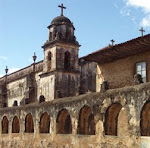
Twice a year, for Semana Santa and Noche de Muertos, artisans from all over Michoacán display their wares around the perimeter of the main plaza in Pátzcuaro. Photo taken on Plaza Vasco de Quiroga. (T. Novinger)
Gente, Pátzcuaro has been discovered by the New York Times.
The bulk of the New York Times Article is as follows:
Move Over Oaxaca, Arty Michoacán Is Calling
By GISELA WILLIAMS
Published: July 20, 2008
It all started with an enormous green ceramic pineapple. Seconds after it caught my eye in the Museo de Arte Popular in Mexico City, I began to covet it. The label revealed that the piece had been made in Michoacán, a Mexican state along the southwest coast. Oddly enough, over the next hour, almost every time an especially fantastic object caught my attention, the provenance on the label was always the same: Michoacán.
By the time I left the museum’s overpriced gift shop, I had it all mapped out: a crafts safari though the region, foraging for the fanciful animal masks and brightly painted mermaid figurines that caught my eye.
There was one little snag: Michoacán is not only one of Mexico’s premier crafts centers; until recently, it was also home to some of Mexico’s most notorious drug kingpins. Less than a decade ago, its coastal highway was nicknamed Bandito Alley, and the region was overrun with marijuana fields and methamphetamine labs.
But in December 2006, just days after President Felipe Calderón was sworn into office, the government launched Operation Michoacán, sending convoys of troops to bulldoze marijuana fields and chase out gangsters and drug dealers. Drug-related violence has fallen in the last year and despite occasional flare-ups — which have been confined to gang-on-gang violence and government crackdowns — Michoacán is beginning to attract visitors besides backpackers and serious collectors.
A new highway, 37, through Michoacán has also helped, enabling travelers from beach towns like Ixtapa-Zihuatanejo to zip up to the charming colonial center of Michoacán in less than three hours. It used to take as much as eight.
A few months after Operation Michoacán was put into action, my husband, Carsten, and I drove west from Mexico City into Michoacán without incident. The only ambush was the orange-and-black clouds of monarch butterflies, fluttering above our windshield. (In March, the butterflies migrate north across Michoacán’s rolling green hills to lay eggs on the milkweed plants of the United States.) And the only indication of a lingering drug problem was a few soldiers patrolling the highway.
But what is a safari without a little adventure? The region has a reputation for a rebellious citizenry, as well as its wildly natural beauty.
The original inhabitants, the Purépecha Indians, were thought to have developed one of the most advanced pre-Columbian societies in western Mexico. Their achievements included unique T-shaped pyramids and tapestries made from hummingbird feathers. While they succeeded in fending off numerous invaders, including the mighty Aztecs, they were eventually conquered (and almost wiped out) by Spanish rifles and the famously brutal Nuño de Guzmán in the 16th century.
An ideal place to be based is Pátzcuaro, a colonial town set above a large blue lake in central Michoacán. Unlike the endless sprawl that surrounds most Mexican cities, the streets leading to Pátzcuaro are hedged by pine trees and old adobes.
While its colonial architecture hasn’t changed much since the 16th century, its residents have. In the last decade, American retirees have swooped into town and turned its historic center into a booming expat community.
Michoacán is “an undiscovered Oaxaca,” said Victoria Ryan, a 62-year-old artist who arrived from New Mexico in 1992 and now runs an upscale B & B named Casa Encantada with her partner, Cynthia de la Rosa. “I felt like I arrived in Sante Fe in the 1940s.”
Down the street from Casa Encantada is Plaza Don Vasco de Quiroga, a small grassy park with towering ash trees and a stone arcade filled with craft shops and cafes. The square was named after a 16th-century bishop, Vasco de Quiroga, who might be called the patron saint of Michoacán crafts-making

Photo taken in Santa Clara del Cobre. (T. Novinger)
A student of Sir Thomas More’s “Utopia,” Quiroga gathered the ravaged Purépecha Indians into several villages around Lake Pátzcuaro, and encouraged each to adopt a specific craft as a means to survival and self-governance. His utopian vision lives on 400 years later: the village of Santa Clara del Cobre is renowned for its copper products, Capula for its rust-colored pottery and Ihuatzio for its woven baskets and mats.
On the cool evening we arrived in Pátzcuaro, the quiet streets were lined with rickety food carts and whitewashed adobes with red tile roofs and matching base trim. It felt like we were walking through a sepia-toned photograph.
For dinner, we ended up at Plaza Chica, a lively square with a packed taco stand where we feasted on soft tortillas filled with spicy beef, onions and cilantro. Along with glasses of horchata, a cinnamon-spiked rice drink, our sidewalk banquet came to less than 20 pesos — under $2 at 10.5 pesos to the dollar.
The next morning, Kevin Quigley, a guide we had hired, was waiting outside the hotel in a beat-up gray van. A 58-year-old expatriate from San Francisco, Mr. Quigley has been offering crafts tours of Michoacán to tourists and professional buyers for 20 years. The plan was to drive to the village of Capula, known for its colorful ceramics. Actually, we were heading to the home and workshop of Juan Torres, one of Michoacán’s best-known artists.
After bumping along a narrow road that wove past fields of tall grass and wildflowers, we pulled up to an adobe-and-glass complex atop a hill covered with cactuses, blooming trees and gigantic copper sculptures. Mr. Torres, a rugged man in his 60s with a graying mustache, greeted us in the driveway and invited us in.
The house itself was a work of art: the front stoop was a mosaic of cow knuckle bones, and a claw-foot bathtub was surrounded by boulders and ferns. Oversized Day of the Dead-themed paintings, a series he was doing for the Universal Culture Forum in Monterrey, were piled up in his airy studio.
Next, we made our way to the ceramic workshop, where Mr. Torres and his wife, Belia Canals Henríquez, produce and sell their colorful Catrinas, which depict elegantly dressed women as skeletons. For about $100, I couldn’t resist taking a foot-tall Catrina home, carefully wrapped in newspaper like a mummy.
Later that afternoon, Mr. Quigley informed me that my coveted green ceramic pineapples, the inspiration of my trip, were made in San José de Gracia, a small village about two hours north of Pátzcuaro. It would have required a half a day and, unfortunately, we didn’t have time; I had plans to continue to the coast.
So the following day, we drove instead to Santa Clara de Cobre, the copper-making village, about 30 minutes to the south. The atelier-lined streets of this quaint town flashed with glittering copper pans, decorative sinks and enormous cauldrons, like the kind witches use in fairy tales.
We wandered into the small showroom of Ignacio Punzo Angel, where about 10 copper and silver vases were on display, ranging in price from several hundred to several thousand dollars. Mr. Angel was behind the counter. I asked a simple question about the work, and it inspired an hourlong conversation about being a metalsmith.
He took us behind the shop to his workshop — complete with open fire, bellows and sledgehammers — and showed us his latest creation: a gorgeous Art Deco-style silver vase that reminded me of a Jean Arp sculpture. It was so spectacular that for a moment I forgot all about green pineapples...
.JPG) Three years ago, I could not find a title company operating in the State of Michoacán, where the colonial pueblo of Patzcuaro is located. In fact, title insurance is not commonly used in Mexico. Therefore I embarked on a practical project to make title insurance available for our real estate purchases here. At a seminar I had attended in Austin, Texas, I took note when a lawyer who practices in both the United States and Mexico stated that First American Title Insurance issues policies for Mexico. Subsequently, I obtained the name of another possible company. After some internet sleuthing and phone calls to both U.S. and Mexico offices, I decided to work with First American’s head office in Florida for Mexico, Latin American & The Caribbean. They employ knowledgeable bilingual attorneys who come from many countries in the Americas.
Three years ago, I could not find a title company operating in the State of Michoacán, where the colonial pueblo of Patzcuaro is located. In fact, title insurance is not commonly used in Mexico. Therefore I embarked on a practical project to make title insurance available for our real estate purchases here. At a seminar I had attended in Austin, Texas, I took note when a lawyer who practices in both the United States and Mexico stated that First American Title Insurance issues policies for Mexico. Subsequently, I obtained the name of another possible company. After some internet sleuthing and phone calls to both U.S. and Mexico offices, I decided to work with First American’s head office in Florida for Mexico, Latin American & The Caribbean. They employ knowledgeable bilingual attorneys who come from many countries in the Americas. The first step was to find a local lawyer/Notario in Pátzcuaro who would be willing to make application to First American Title for approval to do title searches for them in Michoacán; at that time no one in the state had such approval. Arquitecto Luís Stamatio López, a friend with whom we do business in Pátzcuaro, helped me explore local prospects. Although the first few inquiries did not elicit a positive response, Licenciado Ignacio Sandoval Hernández of the Notaría Pública No. 90 in Pátzcuaro indicated his interest and willingness to go through the process. He became the first—and to my knowledge the only—Notario in Michoacán who is approved to do title searches for First American Title.
 Being a pragmatic person, I like to see theory applied. My husband and I had purchased and closed on some contiguous properties in the historic center of Pátzcuaro. To test our system, we applied and paid for a single title insurance policy covering the parcels purchased. Lic. Sandoval issued his title opinion in the format required by First American Title, who requested a few documents. Arq. Stamatio and Lic. Sandoval assisted us to obtain these and in 2007 we received the first Title Insurance Policy from First American Title issued for a property in this area. It is in English and payable in U.S. dollars in the United States (Spanish, Pesos and Mexico, respectively, are options). This trial run was not difficult, but it was time-consuming for me to follow up on details to obtain this first policy.

.jpg)


.JPG)

.JPG)